
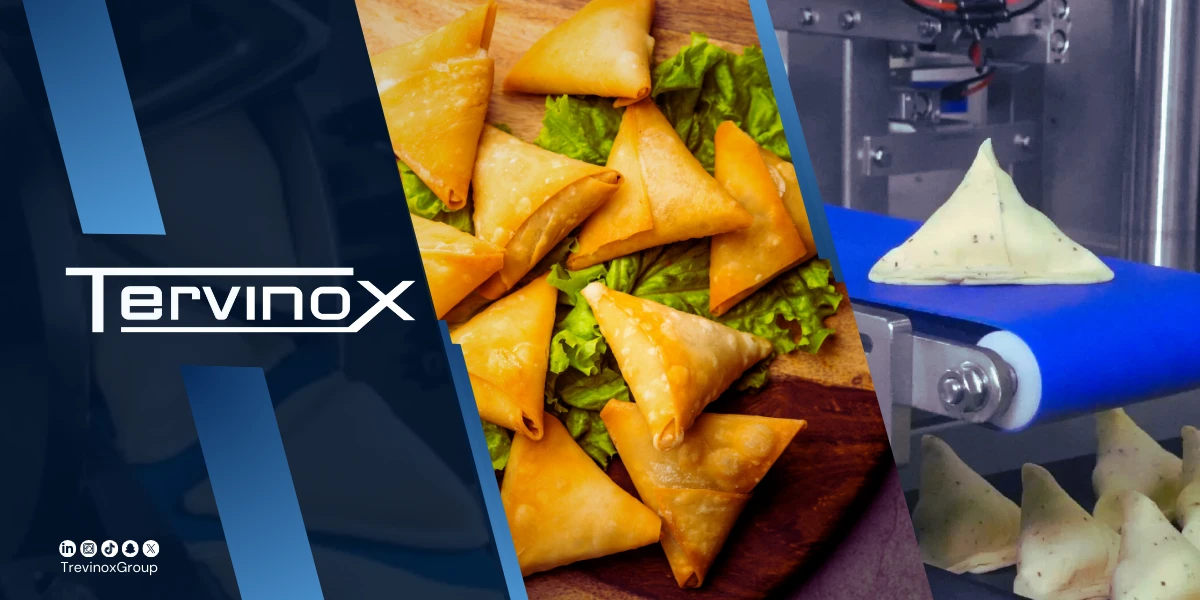
As Ramadan approaches, factory and central kitchen owners face enormous pressure to meet the increasing demand for traditional foods, and here the need to invest in technology appears to ensure both quality and speed. The real challenge is not just buying a machine, but understanding how to choose a samosa and kibbeh production line for Ramadan season that suits your production capacity, dough type, and materials used. At Tervinox, we understand that work continuity during peak times depends on equipment durability and ease of maintenance, so we provide integrated lines that combine engineering precision and ease of operation, ensuring a consistent product that satisfies your customers' tastes and saves you waste costs and exhausting manual labor.
Contact us now to equip your factory with the latest production lines and ensure your complete readiness before the season arrives
How to choose a samosa and kibbeh production line for Ramadan season?
Investing in food equipment requires a thorough examination that goes beyond just price. The primary goal is continuity and quality during high-pressure periods. When thinking about how to choose a samosa and kibbeh production line for Ramadan season, you must consider the line's flexibility in handling different dough mixtures, whether thin samosa dough or kibbeh dough that relies on bulgur and meat.
The ideal line is one that gives you complete control over the filling-to-dough ratio while ensuring tight edge sealing to prevent disintegration during frying or freezing. At Tervinox, we focus on supplying equipment manufactured from materials compliant with international specifications, facilitating daily cleaning and sterilization operations and reducing downtime that may negatively affect your market share during the holy month.
Tips for increasing productivity before peak periods
Preparing for the season begins months before its arrival, as increasing productivity depends on the harmony between machine efficiency and the operating plan. To ensure maximum benefit from your equipment, we recommend following these steps:
- Conduct comprehensive preventive maintenance for all motors and conveyor belts to ensure no sudden stops
- Train human cadres on quickly handling control interfaces to change molds or settings smoothly
- Adjust the cooling and freezing system to match the output speed of products from automated production lines
- Provide essential consumable spare parts in factory warehouses to avoid waiting for supply
- Improve raw material flow from the preparation area to feeding hoppers to ensure circulation continuity
Learn more: Preventive Maintenance vs Reactive Maintenance
Specifications of the best kibbeh machine for large factories
Major factories rely on strict standards when selecting forming machines, looking for power, endurance, and the ability to produce thousands of pieces daily without variation in specifications. The ideal machine specifications are summarized in the following table:
Specification | Technical Description |
|---|---|
Machine body | Fully stainless steel (SS304) to ensure public health and longevity |
Extrusion system | Advanced screw pumps ensuring no heating of dough or filling during forming |
Mold variety | Ability to produce different shapes (oval, spherical, pointed) with weights starting from 10 grams |
Maximum capacity | Production capacity reaching 6000 pieces per hour or more depending on the model |
Easy disassembly | Design allowing food contact parts to be disassembled within minutes for easy washing |
Digital control features (PLC) in dough forming and filling
The Programmable Logic Controller (PLC) system is the intelligent nerve of modern production lines, moving the manufacturing process from manual randomness to ultra-precise engineering accuracy. This system allows the operator to adjust feeding speed and filling quantity with precision down to tenths of a gram, ensuring absolute consistency in final product quality and costs.
Through interactive touch screens, different recipes can be saved for a range of products. With just a button press, the line transforms from producing kibbeh to producing stuffed dough balls, and this versatility is the secret to major brands' success. Tervinox ensures its lines are equipped with the latest software supporting both Arabic and English, making it easy for workers to handle the machine without needing complex programming expertise.
Learn how to extend the life of industrial kitchen equipment
Installation and training services provided by Tervinox
We do not just sell machines; we provide a technical partner that accompanies you on your success journey, as our relationship with the client actually begins after completing the purchase. Our logistical and technical services include:
- Sending a specialized engineering team to supervise line installation and connection to electrical power and air systems
- Providing intensive training courses for operators and supervisors on how to calibrate the machine to achieve the best product texture
- Detailed explanation of daily and weekly maintenance programs to ensure equipment sustainability
- Providing direct technical support via phone or field visits to solve any emergency technical problems
- Offering technical consultations on developing food recipes to suit automated production
Best samosa manufacturing machines for central kitchens
Central kitchens look for equipment that combines relatively small size with high productivity covering the needs of large hotels and restaurants. The best samosa machines rely on a "continuous dough" system where dough is rolled, cut, and filled in one quick cycle, maintaining dough moisture and preventing dryness.
These machines feature a protection system that prevents edge sticking and ensures pieces come out aesthetically mimicking skilled manual work. Investing in this type of equipment reduces dependence on seasonal labor that may lack experience and gives you complete control over final product quality in terms of shape and taste, which raises the market value of your brand in competitive markets.
In conclusion, Ramadan represents the greatest opportunity to achieve exceptional profits, but your success depends on the efficiency of the tools you rely on in your kitchen or factory. Understanding the criteria of how to choose a samosa and kibbeh production line for Ramadan season is the first step toward leadership in the food industry market. At Tervinox, we are committed to providing solutions that balance engineering innovation with economic feasibility to ensure your production continuity with the highest international quality standards. Do not leave your success to chance during the most pressured season of the year, and rely on our expertise in equipping lines that withstand hard work and intensive production.
We invite you to visit our showroom or contact our technical consultants today to get a customized quote that meets your production aspirations and puts you ahead of competitors.
Frequently Asked Questions
What factory space is required to install a complete samosa production line?
The space depends on the line type, but generally a medium production line with cooling conveyors needs at least 40 to 60 square meters to ensure ease of worker movement and maintenance.
Can one machine produce samosa with regular dough and puff pastry dough?
Yes, pressure and dough rolling settings can be adjusted to suit different types of dough, provided appropriate forming molds are used for each type to ensure good sealing.
How are fillings containing large pieces like vegetables handled?
The feeding system in the machine must be designed with wide openings and powerful pumps that prevent pipe blockage. At Tervinox we provide specialized injection heads for coarse fillings.
What is the difference in electricity consumption between traditional and smart machines?
Machines equipped with PLC and Inverter systems are more energy-efficient by up to 30% because they regulate motor consumption based on actual work pressure.
Are machine spare parts available in the local market?
Tervinox ensures all essential spare parts and consumables are available in its warehouses, with fast shipping service to ensure production does not stop for more than a few hours.



