
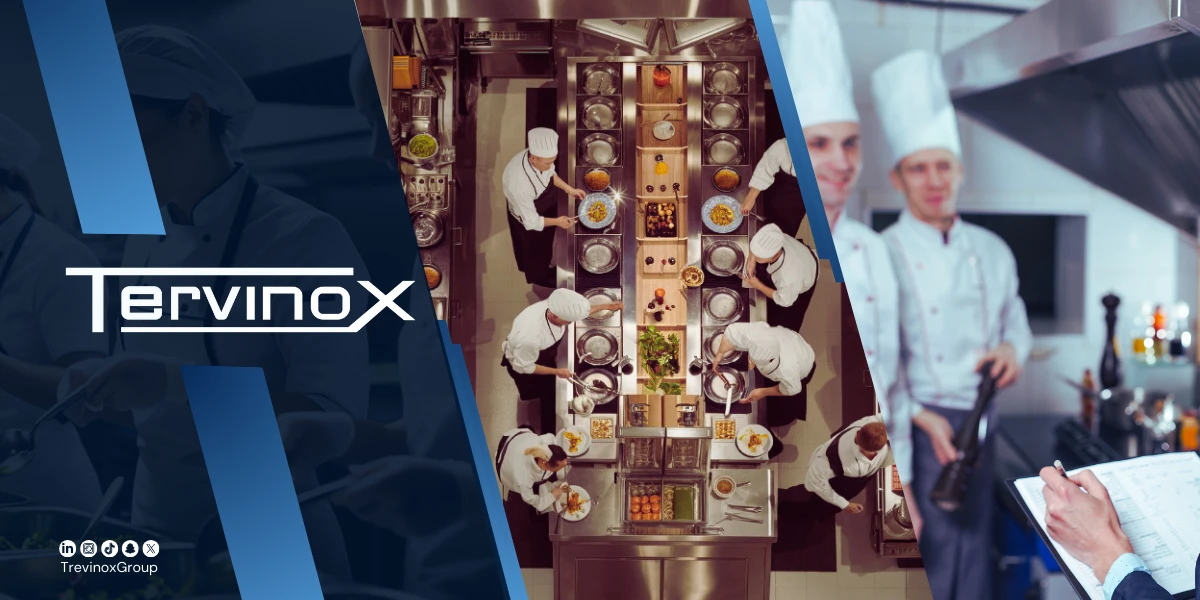
In the busy restaurant world, rush hour often turns into a real test of the team's ability to withstand pressure, where orders accumulate and chances of human error increase. Here appears the fundamental role that standardization plays, not just as an organizational tool but as a cornerstone for transforming that overwhelming chaos into a harmonious and productive working machine. At Tervinox, we believe that taste quality stability and service speed begin with designing a smart kitchen based on fixed operational standards, ensuring each dish exits with the same quality and professionalism, reducing waste and raising your project's operational efficiency to its maximum limits, giving your team complete confidence to work under pressure with total smoothness.
Are you ready to transform your kitchen into a model of professionalism? Contact us at Tervinox today to design solutions ensuring your success sustainability.
Standard Operating Procedures (SOPs) Concept
Standardizing work procedures is the cornerstone that moves the kitchen from the personal efforts stage to the professional institutional stage, where the standardization system represents a precise roadmap for every movement happening inside the establishment.
Having standard operating steps ensures no detail is left to chance, significantly raising operational efficiency and making outputs predictable and always stable.
When each team member clearly understands their tasks, confusion disappears and quality of service provided to customers improves, creating a harmonious work environment capable of handling increasing work pressures without compromising professional standards. This system is the real guarantee for brand sustainability and its ability to grow and expand in the future.
Clear Equipment Operating Manuals to Ensure Sustainability
Investing in professional equipment necessarily requires having an instructional manual for each device to ensure its long lifespan and user safety, including four basic axes:
- Operating steps: Begin by ensuring electrical or gas connections, then activating appropriate temperature or pressure settings for the product type
- Shutdown: Gradual equipment cooling before disconnecting power to avoid thermal shocks that may damage internal components
- Cleaning operations: Using specialized chemicals that don't cause stainless steel corrosion, focusing on difficult corners to prevent bacterial accumulation
- Basic maintenance: Periodically checking filters and connections to ensure no leaks or blockages impeding the device's overall performance
Reducing Dependence on Individuals and Facilitating Training
The biggest challenge restaurant managers face is losing expertise when a competent employee leaves, and here appears the power of standardization in transferring knowledge from individuals' minds to establishment records. When documented work manuals are available, training new employees becomes a quick and systematic process that doesn't take long, as the trainee follows pre-determined steps to reach the required result.
This approach reduces the skill gap between employees and prevents information monopoly, giving management high flexibility in task distribution and ensuring workflow continues with the same efficiency regardless of changing faces or shifting shifts, which enhances overall system stability.
Learn more: Preventive Maintenance vs. Reactive Maintenance: Which is More Cost-Effective for Your Restaurant?
Controlling Waste and Achieving Final Product Quality
Process standardization directly affects profitability through strict control of kitchen inputs and outputs, contributing to:
- Reducing waste: Through adhering to precise quantities for each item, preventing excessive raw material use
- Controlling portion sizes: Ensuring each customer receives the same amount every time they visit the restaurant, enhancing trust and loyalty
- Taste consistency: Relying on fixed thermal and time standards ensures food ripens to the same degree without variation
- Cost savings: Controlling loss means reducing meal cost and noticeably and gradually increasing net profits
Practical Steps for Gradual Standardization Implementation
Work culture cannot be changed overnight, so a gradual implementation strategy must be followed to ensure team acceptance and understanding of the new system. You should start first with critical devices whose breakdown leads to complete production stoppage, such as central ovens or cooling units, by placing instructional stickers on them.
After that, move to operations with the greatest impact on cost and time, such as initial preparation operations (Prep Area). This gradation allows error monitoring and course correction without causing shock to daily workflow, making employees themselves feel the practical benefits of the system in terms of reducing physical effort and increasing organization.
Tervinox Equipment and Its Role in Operational Efficiency
Tervinox company relies on providing comprehensive engineering solutions that integrate durability and modern technology to support the standardization system in your kitchen.
We provide a wide range of equipment specifically designed to facilitate repetitive operations and ensure their accuracy, starting from preparation tables manufactured from the finest bacteria-resistant stainless steel types, to smart cooling and cooking systems giving you complete temperature control.
Choosing Tervinox equipment means obtaining work tools designed to reduce human error and facilitate periodic maintenance operations, ensuring you a kitchen that works like a Swiss watch in the finest production and service details.
Equipping Central Kitchens: How to Start with Global Specifications
Establishing central kitchens requires engineering vision that goes beyond merely stacking equipment, as success in this massive investment depends on applying the standardization system from the first design moment. To start your project with global specifications, space planning must be based on the direct workflow concept to prevent path intersection between raw materials and ready products, ensuring the highest food safety standards. Relying on advanced technical equipment and organized cooled storage spaces is not a luxury but a necessity to control operational costs and maintain quality in all affiliated branches. By choosing the correct standard specifications, you lay the solid foundation for your brand's growth and its ability to produce intensively without any decline in service level or taste.
Learn more: Improving Energy Efficiency in Commercial Kitchens
Basic Pillars for Establishing a Professional Central Kitchen
To ensure the central kitchen operates as an integrated system subject to unified operational standards foundations, focus must be on the following points:
- Material selection: Complete reliance on high-quality stainless steel (grade 304) in all work surfaces and equipment to ensure maximum corrosion and rust resistance and easy sterilization
- Path engineering: Designing wide corridors allowing smooth movement of carts and employees, separating initial preparation areas from final cooking areas to avoid cross-contamination
- Smart storage systems: Providing large-capacity cooling and freezing rooms equipped with digital thermal monitoring systems ensuring food inventory safety preservation for long periods
- Rapid cooking technology: Integrating equipment capable of producing huge quantities in record time while maintaining required standard accuracy for each recipe (Consistent Quality)
- Strong infrastructure: Implementing drainage networks, water supply, and ventilation that withstand continuous work pressure and facilitate daily deep cleaning operations
Final Thoughts
Ultimately, the secret of any restaurant or central kitchen's success lies in the extent of operational discipline and ability to apply standardization with strictness and professionalism. The transformation from manual work based on guessing to systematic work is what makes the difference in today's competitive market. At Tervinox, we are not just equipment providers but your partners in building your success story, where we offer you technical expertise and advanced tools that make your kitchen a productive, safe, and organized environment to the maximum extent. Investing in quality today is the only guarantee to avoid repair costs and waste tomorrow, and we are here to walk with you in every step toward the top.
Are you looking to establish a kitchen combining high efficiency with global quality? Contact the expert team at Tervinox now for comprehensive consultation and equipment placing your project at the forefront of competitors.
Frequently Asked Questions
Does standardization affect chefs' creativity?
On the contrary, standardization organizes routine and boring operations, freeing the chef's mind for creativity in developing new recipes instead of being occupied with solving daily organizational problems.
What is the fastest way to monitor adherence to unified standards?
Daily checklists are the fastest tool, where the supervisor reviews specific points before and after each shift to ensure approved procedures are executed accurately.
How does good ventilation contribute to standardized work system success?
Kitchen temperature affects equipment efficiency and employee concentration; therefore designing advanced ventilation systems prevents thermal stress and maintains sensitive device performance stability.
Does process standardization require a huge budget to implement?
Standardization is primarily an administrative system based on organization and documentation, and can be started with simple capabilities, but results appear faster when using equipment supporting these standards.
What is the expected lifespan of stainless steel equipment when following maintenance procedures?
When adhering to unified cleaning and maintenance protocol, equipment manufactured from high-quality materials can last more than 15 years with full operational efficiency.



