
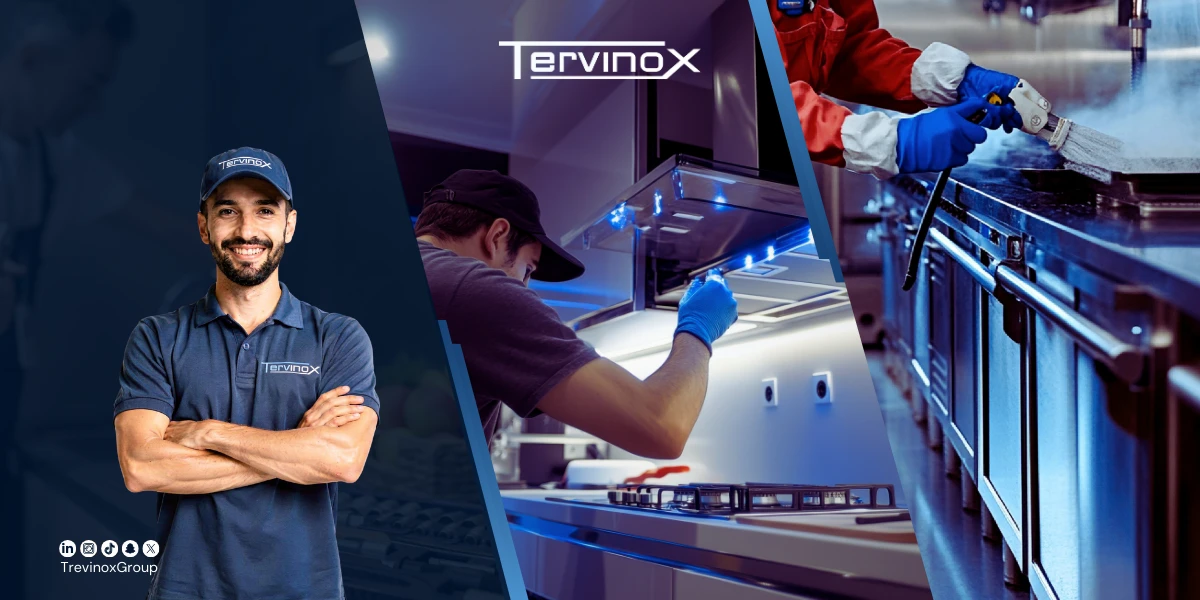
Running a successful restaurant does not only mean serving delicious food but also ensuring your equipment works like clockwork without sudden stops that disrupt your team. Many restaurant owners fall into the trap of waiting for breakdowns to fix them, but have you ever calculated the cost of your refrigerator stopping for hours during peak business? When comparing preventive maintenance vs. reactive maintenance, we find the issue goes beyond just repairing equipment. It relates to protecting your profit margins and kitchen stability. The smart choice is always to anticipate the problem before it occurs to save expensive emergency expenses. Efficiently operating equipment means faster service and happier customers, and this is exactly what makes the difference in a competitive market.
Let Tervinox take care of protecting your equipment with thoughtful and practical maintenance plans. Contact us now to ensure your kitchen's efficiency and business continuity without surprises.
Preventive Maintenance vs. Reactive Maintenance: Which is Best for Your Business?
When we talk about restaurant asset management, choosing between preventive maintenance vs. reactive maintenance is a choice between advance planning or working under crisis pressure. Reactive (or corrective) maintenance relies on the principle "don't fix it until it breaks," which seems cost-saving initially due to not paying monthly costs, but in reality puts you at the mercy of sudden breakdowns that may completely stop your kitchen on a busy night.
In contrast, preventive maintenance that we adopt at Tervinox focuses on scheduled periodic inspection to discover small problems before they escalate. This approach gives you peace of mind and the ability to control your budget accurately.
Key operational differences:
- Timing: Reactive occurs after breakdown, preventive precedes it.
- Cost: Reactive is unpredictable and often high, preventive is fixed and planned.
- Expected lifespan: Reactive reduces equipment life due to stress, preventive extends it.
- Safety: Reactive increases accident risks, preventive ensures safe work environment.
Learn about: Modern Commercial Refrigeration Systems
Cost of Sudden Breakdowns vs. Regular Maintenance Schedules
Many restaurant owners overlook the hidden cost of reactive maintenance. The matter is not limited to just the repair technician's bill. When a storage refrigerator suddenly breaks down, you lose food inventory worth thousands, in addition to sales loss resulting from menu items unavailability, not to mention fast shipping costs for spare parts and overtime wages for technicians in emergency cases.
In contrast, regular maintenance schedules allow you to pay small and predictable amounts that protect you from these financial disasters. The following table shows an approximate financial comparison of the material impact of each type:
| Comparison Aspect | Preventive Maintenance (Scheduled) | Reactive Maintenance (Emergency) |
| Labor Cost | Normal and pre-planned | Doubled (emergency and after-hours wages) |
| Spare Parts Cost | Regular purchase at market prices | Fast and costly shipping for operational necessity |
| Operating Losses | Zero (maintenance done outside peak hours) | Very high due to production stoppage |
| Asset Value | Remains high for future sale | Decreases rapidly due to frequent breakdowns |
Digital Transformation: Performance Tracking and Task Records
Old papers and notebooks are no longer useful in modern professional kitchens, so using digital systems to record the history of each equipment is a pivotal step for operational success.
The digital system allows you to know the medical history of each oven or refrigerator, when it was last serviced, and what spare parts were replaced, helping you make decisions based on accurate data instead of guesswork.
This documentation also helps you comply with health and legal requirements easily, as you can prove your equipment's efficiency with one click.
Benefits of keeping a digital maintenance record:
- Predicting equipment deterioration timing and planning for replacement before stoppage.
- Facilitating handover process between branch managers or maintenance teams.
- Monitoring breakdown frequency for the same device to discover manufacturing defects or misuse.
- Adjusting annual budget based on actual maintenance spending reports.
Periodic Calibration for Ovens and Fermentation Equipment
Maintenance is not limited to mechanical repair but includes precise calibration that ensures food quality and consistent taste you offer your customers. Ovens and fermentation devices that do not undergo calibration may give wrong thermal readings. The indicator may show 200 degrees while the actual temperature is only 180, leading to undercooked or burnt food, thus wasting ingredients and increasing customer complaints.
Regular calibration service ensures your temperature and humidity sensors work with extreme precision, maintaining your restaurant's standard recipes.
Signs your equipment needs calibration:
- Different baking color in baked goods within the same tray.
- Taking longer than usual to reach required temperature.
- Noticeable increase in gas or electricity consumption without change in work volume.
- Illogical fluctuation in digital thermostat readings.
Critical Spare Parts Inventory Management Strategy
One of the worst nightmares for a restaurant manager is a critical equipment stoppage and waiting for a spare part imported from abroad that takes weeks to arrive. To reduce downtime, you must have a smart emergency inventory containing consumable parts most prone to damage that cause immediate operational stoppage.
By coordinating with Tervinox, you can determine a list of these parts and provide them inside your restaurant to ensure immediate repair. This simple procedure transforms a breakdown that may last days into a simple repair taking minutes.
- Conveyor belts: For mixers and motors.
- Door gaskets: For refrigerators and ovens to prevent heat leakage.
- Water and air filters: To ensure machines operate efficiently and protect internal parts.
- Temperature sensors: For safety systems in ovens and fryers.
Learn about: Best Commercial Coffee Equipment for Cafés in Saudi Arabia
Investing in Staff Training: Prevention Starts with the Operator
Statistics confirm that a significant percentage of kitchen equipment breakdowns are primarily due to operating errors and not defects in the machine itself. Investing in training your staff on the correct way to handle equipment is the first line of defense in the preventive maintenance system.
When an employee understands how to operate the oven, how to clean the coffee machine without damaging connections, and when they should stop and call the technician, you save enormous amounts that would have been spent on repairs that could have been avoided. Training is not a one-time event but an ongoing culture.
Steps for an effective staff training program:
- Provide simplified operation manuals and explanatory stickers next to each equipment.
- Conduct short workshops when receiving new equipment.
- Assign a primary maintenance officer from staff to monitor daily use.
- Link incentives to maintaining equipment cleanliness and safety to increase sense of responsibility.
In the end, successful restaurant management depends on being proactive, not reactive. The equation of preventive maintenance vs. reactive maintenance clearly tips the scales in favor of prevention, as it is the investment that protects your capital and ensures continuous profit flow without unpleasant surprises. Remember that equipment is your restaurant's beating heart, and neglecting it simply means risking your project's reputation and the quality of what you offer. We at Tervinox understand the size of challenges you face and are ready to be your technical partner who carries the burden of equipment maintenance off your shoulders, so you can focus on what you excel at: delighting your customers and serving the most delicious dishes. Start today by changing your strategy toward safety and sustainability.
Frequently Asked Questions
Is preventive maintenance suitable for small restaurants with limited budgets?
Yes, it is more cost-effective for small restaurants because any sudden breakdown may consume the entire month's budget, while prevention costs are divided and simple.
What is the expected lifespan of kitchen equipment with maintenance commitment?
Commitment to periodic maintenance may add 3 to 5 additional years to equipment life compared to those operating on repair-when-broken system.
Do maintenance contracts cover replacing damaged parts free of charge?
Contracts usually cover labor wages, visits, and inspection, while spare parts are calculated separately except in special comprehensive warranty cases.
How do I know the maintenance company I deal with provides good service?
Quality is measured by response speed, availability of original spare parts, providing transparent technical reports after each visit, and low recurrence of the same breakdown after repair.
Can internal staff perform preventive maintenance without using a company?
They can perform cleaning tasks and simple visual inspection (first-degree maintenance), but technical inspection and calibration need experts and specialized equipment to ensure safety.



