
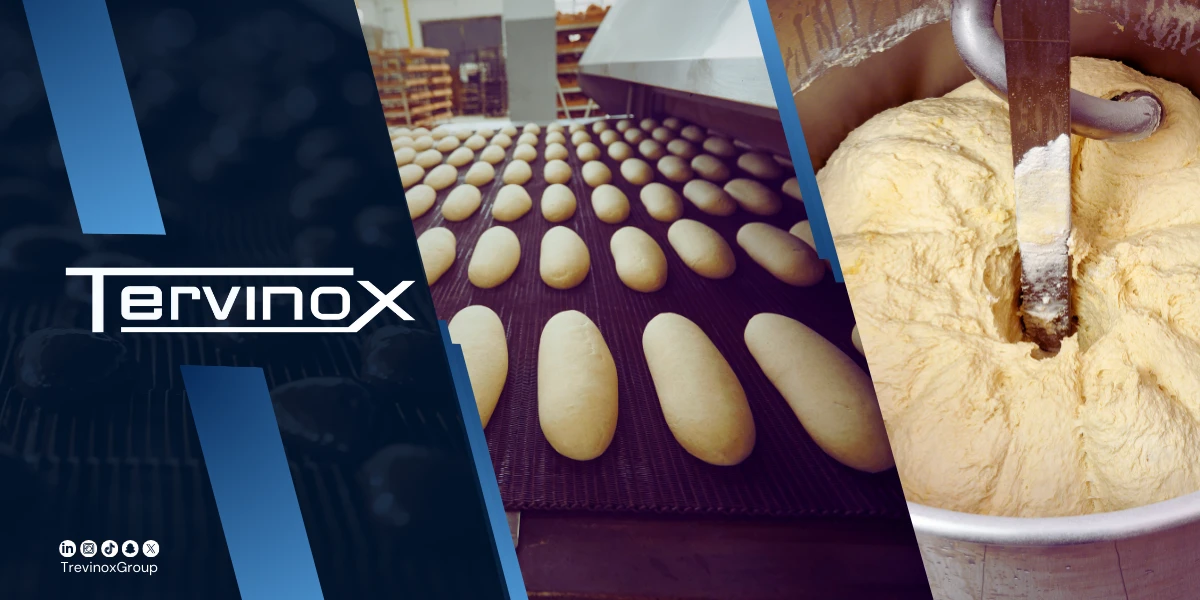
Every bakery expert knows that equipment is the backbone of production and not just auxiliary tools. When planning your project, you will face multiple options, but real success lies in precision when choosing the right commercial bakery equipment suited to your operations. It goes beyond buying an oven and a mixer; it is an integrated system that starts with precise dough mixing, continues with controlled fermentation, and ends with perfect baking. Choosing the right equipment reduces raw material waste, ensures consistent product quality daily, and saves on maintenance costs. Invest in equipment that can withstand continuous operation to guarantee the stability and growth of your business.
If you are looking for production lines or ovens you can rely on for many years, Tervinox provides complete solutions with global quality and real warranties. Contact us now to equip your bakery with the latest technologies that guarantee efficiency and speed.
The difference between small bakeries and large factories
When planning to invest in this sector, you must understand that the types of commercial bakery equipment vary significantly based on the business model. Small bakeries (Artisan Bakeries) rely on flexibility and a variety of products in limited quantities, which requires versatile, compact equipment.
In contrast, large factories focus on mass production of one or two product types (such as Lebanese bread or toast), requiring fully automated production lines that operate for long hours without interruption to reduce unit cost. The following table highlights the key differences to consider when purchasing:
| Comparison Aspect | Small Bakeries (Local) | Large Factories (Automated) |
|---|---|---|
| Type of Equipment | Separate units (mixer, oven, divider) | Continuous production lines (conveyor belts) |
| Operational Goal | Artisan quality and daily product variety | Speed, consistency, and large quantities |
| Required Space | Limited spaces (retail stores) | Large industrial halls |
| Operating Costs | Relies more on skilled labor | Relies on energy and maintenance costs |
Standards for selecting chocolate and pastry equipment
Equipping a chocolate and pastry section requires extreme precision, beyond traditional bakeries, as handling cocoa and its derivatives demands precise temperature control to ensure ideal shine and texture. When selecting these machines, do not just focus on price but on the machine’s ability to maintain consistent tempering of chocolate, as any thermal fluctuation results in dull, easily melting final products. Also, ensure the stainless steel used does not react with sensitive food materials.
Thermal control system: Machines must have highly accurate sensors to automatically switch cooling and heating.
Ease of cleaning: Pastry ingredients are sticky, so detachable parts should be easy to clean to prevent bacterial buildup.
Versatility: Choose machines that support add-ons like enrobers to increase productivity in the future.
Mixing speed: Ensure variable mixing speeds to suit different fillings (Ganache vs Praline).
Classifying equipment by production volume
Determining production capacity is the first step before purchasing any piece of equipment. Buying equipment beyond your needs is a waste, while buying less will choke production. Automated bakery equipment is usually classified into three main categories that determine the technology used. The first category suits beginners or limited production, while higher categories require investment in the facility’s infrastructure. Practical classification:
Manual/Limited production equipment: Small vertical mixers and convection ovens, suitable for cafes and small pastry bakeries with daily production not exceeding 500 pieces.
Semi-automatic production equipment: Large-capacity spiral mixers and dough dividers & rounders, suitable for medium-sized tourist and French-style bakeries.
Industrial production lines (Full Automatic): Connected fermentation and baking tunnels with cooling towers, used by factories supplying supermarkets, producing thousands of loaves per hour.
The difference between deck ovens and rotary ovens in bread quality
Many bakery owners are unsure when choosing between these two types. The deciding factor is the product type. Deck ovens rely on stationary heat and thermal conduction through stone floors, ideal for baked goods requiring a firm base and thick crust, like European bread and pain au levain.
Rotary ovens rely on convection and circulating hot air, ensuring even color and heat distribution across all trays simultaneously.
Deck Oven: Best for heavy pastries, delicate sponge cakes, and products needing bottom heat for proper rise.
Rotary Oven: Best for fast mass production, small pastries (rolls), cookies, and soft bread requiring uniform coloring from all sides.
Energy consumption: Rotary ovens are generally more energy-efficient during continuous full-capacity operation.
Space: Rotary ovens use vertical space, while deck ovens need more horizontal space, important for compact stores.
Types of egg and cream mixers for patisseries
In patisserie, spiral mixers alone are insufficient; planetary mixers are needed for airy, fluffy textures. They rotate both around themselves and the bowl simultaneously, ensuring all ingredients are evenly mixed.
Each specialized attachment serves a unique function:
Wire Whip: Incorporates air into creams, egg whites (meringue), and light sponge cakes.
Flat Beater: For dense cakes, cookie dough, frosting, and mashed potatoes; mixes without adding excess air.
Dough Hook: Used for strong mixers to knead small quantities of pizza or pastry dough; not a replacement for the main mixer.
Mixing Bowl: Ensure it is made from food-grade 304 stainless steel to prevent taste changes or metal reaction.
Buying bakery equipment from Tervinox
Working with Tervinox is not just a sale; it is a strategic partnership ensuring your project’s continuity. Investing in commercial bakery equipment through us gives you engineering expertise to design production lines that reduce waste and increase efficiency.
We provide realistic solutions that suit your budget and space while ensuring original spare parts and routine maintenance to prevent unexpected production downtime.
Technical consultation: We help select machines suited to your actual production capacity to avoid unnecessary costs.
After-sales service: A specialized maintenance team ready to act quickly, as every hour of downtime means financial loss.
Variety and quality: A wide range of high-quality European and local equipment covering all production stages from mixing to packaging.
Training: We train your team to operate the equipment correctly to maintain the machines’ expected lifespan.
Frequently Asked Questions
Do you provide water chillers for dough? Why are they important?
Yes, we offer various capacities. They are essential, especially in summer, to control dough temperature and prevent premature fermentation, ensuring proper bread texture.
What is the purpose of proofing chambers, and can they be skipped?
Not recommended for commercial bakeries. Proofing chambers regulate humidity and temperature precisely, ensuring dough rises evenly and perfectly, which cannot be achieved in a variable room temperature.
Do you offer slicers for toast and European bread?
Yes, we have manual and automatic slicers with sharp blades and adjustable or fixed spacing (on request) for professional cutting without crumbling and minimal waste.
Do you provide energy-saving solutions for large ovens?
Yes, most modern ovens we provide have high-density thermal insulation and smart burners to reduce gas or electricity consumption and prevent heat leakage.
Can a production line be customized?
Yes, Tervinox designs and manufactures production lines and equipment to fit your factory space and product type, whether Arabic bread, Western bread, or pastries.



